Language and Market Coverage Boundaries: How to Plan Multilingual Scope and Regional Handoff Limits
Expanding into multiple markets does not require claiming universal fluency—here is how operations leaders set practical language tiers, territory boundaries, and human-handoff limits.
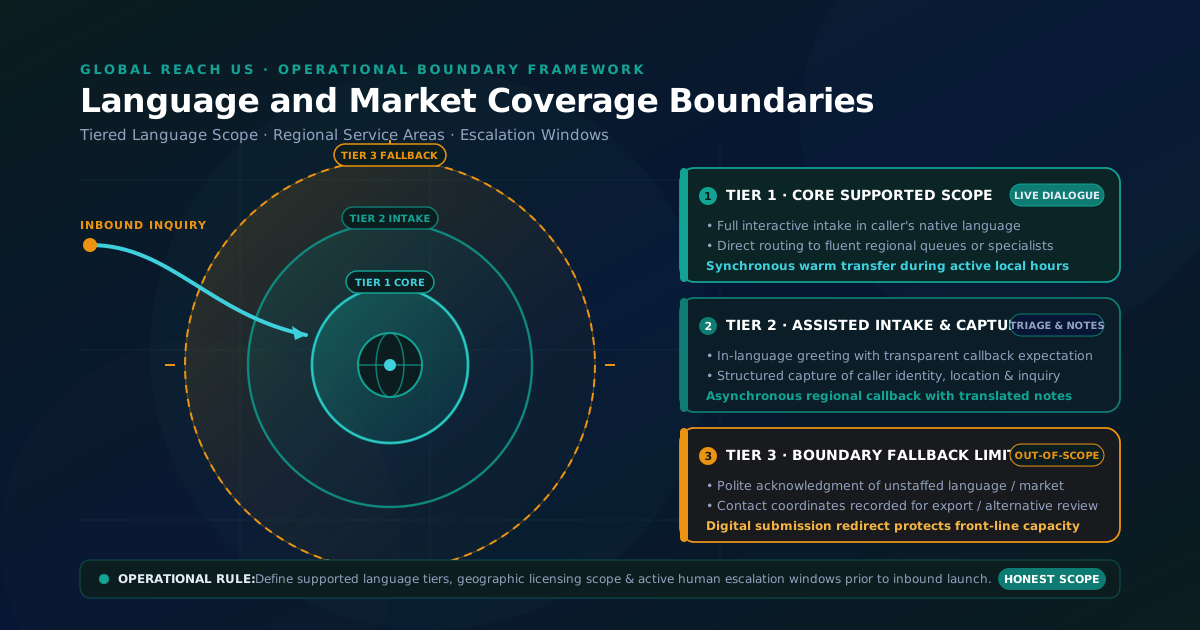
When an expanding business starts fielding calls from multiple countries, operations leaders often feel pressured to project universal global availability. The marketing impulse is understandable: no company wants to tell prospective international buyers that their inquiries might hit an operational boundary.
In practice, claiming unbounded global capability creates severe operational vulnerabilities. When an organization implies that it offers fluent native conversation in every language, unrestricted service across every geographic market, and instant live human transfers in every time zone, frontline teams quickly become overwhelmed. Callers arrive with expectations that no growing operations team can satisfy:
- A caller in Seoul expects real-time technical dispute resolution in Korean, but the company only employs North American daytime engineers.
- A distributor in Munich assumes your sales desk can quote prices compliant with German commercial law on the spot, but your European representative is out of the office.
- A customer in Brazil leaves an urgent voice request in Portuguese, but the message is routed to an English-only support queue where it sits unacknowledged for two days.
The direct answer is that sustainable multi-market call handling requires explicit operational boundaries: defining specific language support tiers, establishing verified geographic service territories, and documenting clear time-zone escalation windows before answering inbound international calls.
Setting coverage boundaries is not an admission of weakness. It is the foundation of dependable cross-market operations. When a business makes its language tiers, geographic limits, and handoff rules explicit, international callers receive structured, predictable assistance rather than broken promises.
The danger of unbounded global claims
Before configuring an inbound call route, an operations team must acknowledge the real risks of overpromising international coverage. Unbounded global claims create four distinct operational failure modes:
- Superficial fluency vs. deep domain comprehension: An automated system may be capable of greeting a caller in dozens of languages, but handling complex technical inquiries, contract negotiations, or regulatory discussions requires deep, specialized domain knowledge. If an intake flow pretends to offer full operational fluency where it only has basic greeting capability, callers quickly become frustrated when the conversation moves beyond simple pleasantries.
- Regulatory, licensing, and commercial mismatch: Offering unrestricted phone intake in a country where your business cannot legally sell, deliver, or support products wastes commercial resources. If a caller spends ten minutes qualifying an order only to learn that export restrictions or lack of local licensing prevent delivery, both the customer and the sales desk lose valuable time.
- Broken human escalation loops: An automated phone agent can answer 24 hours a day, 7 days a week across all time zones. However, human subject-matter experts work in specific time zones. Claiming 24/7 human availability when your regional desks work standard business hours creates an expectation of immediate live transfer that inevitably breaks down outside local office hours.
- Context fragmentation across regional silos: When coverage boundaries are undefined, incoming international requests are frequently forwarded to generic company inboxes. Without clear language paths or territory ownership, regional desks assume another office will follow up, stranding the caller between time zones.
To prevent these breakdowns, an operations leader must replace vague "worldwide" assertions with structured coverage tiers.
Defining your language support tiers
Rather than treating language capability as an all-or-nothing proposition, an effective cross-market operation establishes three distinct tiers of language support. This tiering framework allows an inbound phone agent to greet and assist callers respectfully while setting honest expectations about subsequent human interactions.
- Tier 1: Core Supported Languages: Full interactive dialogue and intake; approved qualification questions in-language; direct routing to native-language regional queues or specialists.
- Tier 2: Assisted Intake & Structured Capture: Language recognition and verified greeting; structured capture of caller identity, location, and inquiry; explicit callback expectation with translated notes.
- Tier 3: Unsupported / Boundary Languages: Polite acknowledgment of unsupported language; capture of contact number and email for alternative follow-up; clear direction to digital or written submission channels.
Tier 1: Core supported languages
Core supported languages represent the primary markets where your business possesses both automated intake capabilities and qualified human staffing. In Tier 1 languages, the inbound phone agent executes full language-aware intake flows:
- Welcomes the caller natively without forcing an unnatural language switch.
- Asks structured qualification questions regarding the caller's organization, project scope, and urgency.
- Captures detailed caller responses and routes them directly to regional staff fluent in that language.
- Enables live synchronous warm transfer during active regional office hours.
Tier 2: Assisted intake and structured capture
Secondary languages represent expanding or emerging markets where your organization wants to welcome callers professionally but lacks dedicated live native-speaking phone desks. In Tier 2 languages:
- The agent identifies the incoming language and provides a clear, polite in-language greeting.
- The agent informs the caller that their request will be captured for a regional specialist.
- Structured details are captured: caller name, organization, phone number, email address, time zone, and primary inquiry.
- The call concludes with a realistic callback expectation (e.g., follow-up via email or scheduled callback from a bilingual representative during specific hours).
- Structured intake notes and transcripts are made available to the assigned regional team with translation context.
Tier 3: Unsupported languages and boundary fallback
No growing business can support all world languages. For inquiries in languages outside Tiers 1 and 2:
- The system politely acknowledges that real-time phone support in that language is currently unavailable.
- The agent offers to record basic contact information (phone number, company name, email address).
- The caller is directed to alternative channels, such as a localized website form or email address, where written translation tools can facilitate communication.
- Frontline teams are protected from receiving unserviceable, unclassified voice tickets that linger indefinitely.
Mapping geographic and market service boundaries
Language is only one dimension of cross-market coverage; geography and commercial jurisdiction are equally critical. A caller dialing from Frankfurt in English might be fully understood by a North American sales rep, but if the inquiry concerns an EU-regulated medical device that your company is only licensed to sell in the United States and Canada, the conversation cannot proceed to a sale.
When planning your coverage boundaries, evaluate four geographic criteria:
- Commercial territory eligibility: Where is your company actively licensed, registered, and staffed to do business? Explicitly catalog the countries and territories where you accept inquiries for new business, versus territories restricted to authorized regional distributors.
- Product and service deliverability: Can your logistics or technical field teams actually deliver and support products in the caller's country? If shipping or field service is unavailable in a specific market, the intake agent should capture the inquiry as an out-of-territory request rather than routing it to a standard regional sales quota desk.
- Regulatory and compliance fences: Are certain product lines subject to export restrictions, data residency requirements, or local certifications? Establishing pre-routing qualification questions prevents representatives from making commitments in non-compliant jurisdictions.
- Distributor vs. direct-sales boundaries: In many international markets, companies sell through third-party distributors or regional partners rather than direct subsidiaries. When an inbound inquiry arrives from a partner-managed country, the flow should identify the territory early and route caller details to the authorized local distributor rather than internal sales teams.
Time-zone escalation and human-handoff limits
An inbound AI phone agent operates around the clock, but your human workforce does not. A core operational error in international call handling is failing to define what happens when a call arrives outside the receiving team's business hours.
To establish reliable next-step ownership, an operations team must divide call handling into two distinct operational modes:
Synchronous live transfer windows
Synchronous transfers (connecting the caller directly to a live human representative while on the line) are only possible during active regional office hours.
- Define active desk hours: Document the exact local hours (e.g., 09:00 to 17:00 Central European Time) when regional staff are staffed to take live transfers.
- Verify live desk availability: Before attempting a transfer, the system must check whether the regional queue is staffed and accepting calls. If all representatives are occupied or in meetings, the flow must transition smoothly to intake capture rather than letting the caller ring endlessly.
- Preserve intake context: The live agent receiving the transfer must receive the caller's name, company, language path, and stated purpose so the caller is never asked to restart their inquiry from zero.
Asynchronous regional callback commitments
When an international call arrives outside local business hours—or when no live agent is free—the flow must execute an asynchronous handoff.
- Transparent status communication: The agent clearly explains that the regional office is currently closed and states the expected response window (e.g., "Our European operations team opens at 09:00 CET, and a representative will review your request during morning hours").
- Structured intake completion: The agent captures all relevant technical and contact details, ensuring the regional desk has complete context upon opening.
- Designated fallback owner: Every after-hours intake must route to a designated human queue lead or regional triage manager who is accountable for assigning callbacks each morning.
Market and language coverage planning worksheet
Use this blank planning worksheet to map your organization's language tiers, geographic boundaries, receiving teams, and escalation paths before launching or expanding inbound phone coverage.
| Planning Dimension | Market / Region 1 | Market / Region 2 | Market / Region 3 | Out-of-Scope Fallback |
|---|---|---|---|---|
| Target Geography / Countries | (e.g., North America: US, CA) | (e.g., DACH: DE, AT, CH) | (e.g., Brazil & Cono Sur) | (All other unlisted territories) |
| Designated Language(s) | (e.g., English, Spanish) | (e.g., German, English) | (e.g., Portuguese, Spanish) | (All unconfigured languages) |
| Language Support Tier | Tier 1 or Tier 2 | Tier 1 or Tier 2 | Tier 1 or Tier 2 | Tier 3 (Boundary Fallback) |
| Intake Depth & Purpose | (Sales qualification & service triage) | (Distributor routing & technical sales) | (Inbound lead intake & quote requests) | (Basic contact info & digital redirect) |
| Receiving Human Desk / Queue | (US Central Operations Desk) | (European Partner & Sales Desk) | (Latin America Regional Queue) | (Global Inbound Triage Inbox) |
| Active Live Transfer Window | (08:00–18:00 US Central Time) | (09:00–17:00 Central European Time) | (09:00–17:00 Brasília Time) | (None — Asynchronous only) |
| Asynchronous Callback SLA | (Next business day by 10:00 CT) | (Next business day by 11:00 CET) | (Next business day by 12:00 BRT) | (Within 2 business days via email) |
| Commercial / Regulatory Fences | (Direct fulfillment; FDA compliant) | (CE Mark required; direct & channel) | (Authorized distributor fulfillment) | (No direct fulfillment available) |
| Human Escalation Owner | (Regional Sales Ops Lead) | (EU Managing Director / Triage) | (Channel Distribution Manager) | (Central Operations Supervisor) |
Note: This worksheet is an illustrative operational planning tool. Customize territory rows, language tiers, and working hours to match your approved staffing capabilities.
An illustrative scenario: Industrial equipment exporter
To understand how coverage boundaries function during everyday operations, consider an illustrative scenario involving a growing mid-sized manufacturing organization.
Organization: "Vanguard Industrial Machinery"
Operations Profile: Headquartered in Ohio, selling CNC tooling equipment directly in North America and through authorized distribution partners across Western Europe and Latin America.
Staffing Constraints: Dedicated engineering and sales staff in Ohio (US Eastern Time); bilingual regional sales manager in Frankfurt (Central European Time); third-party distributor network in Latin America with no direct company employees.
The operational boundary design
Rather than advertising universal global coverage, Vanguard's operations lead maps explicit boundaries across three regions:
- North America (Tier 1 English, Tier 1 Spanish): Full interactive qualification for machinery inquiries. Live warm transfers between 08:30 and 17:30 US Eastern Time to Ohio sales engineering. After-hours intake captured with next-morning callback routing.
- Western Europe (Tier 1 English, Tier 2 German/French): Inbound callers in English and German receive language-aware greetings. During Central European business hours, inquiries route to the Frankfurt desk. Outside European business hours, the agent captures structured technical specifications, verifies EU country delivery requirements, and routes notes to Frankfurt for morning review.
- Latin America (Tier 2 Spanish/Portuguese): The agent greets callers in Spanish or Portuguese, confirms their country (e.g., Mexico, Brazil, Colombia), and captures equipment model interests and contact information. The call flow explicitly explains that Vanguard fulfills orders in their region through authorized distributor partners. The structured lead record is then delivered to the appropriate regional partner rather than entering North American direct queues.
- All other inquiries (Tier 3 Fallback): Callers from Asia-Pacific or Africa are welcomed in English, informed that direct phone support in their local timezone is not currently staffed, and provided an opportunity to leave contact coordinates for export sales review via email.
The operational result
When a factory purchasing agent dials from São Paulo at 15:00 local time:
- The caller is greeted in Portuguese and guided through structured intake questions regarding machine requirements.
- The system does not pretend that an Ohio engineer is ready for a live Portuguese phone conversation.
- The system captures the company name, machine tonnage requirements, delivery location, and callback email.
- The intake record is packaged with structured translation notes and automatically routed to Vanguard's authorized Brazilian distributor queue.
- The distributor contacts the buyer the following morning with full context, while Vanguard's North American team avoids fielding unserviceable out-of-territory phone calls.
This scenario is an illustrative example designed to demonstrate workflow planning; it does not represent an actual customer endorsement or specific transaction.
Operating boundaries and honest technical capabilities
To maintain commercial integrity and prevent misunderstandings, operations leaders must understand exactly what an inbound AI phone agent does and does not do.
What Global Reach US does
- 24/7 inbound voice response: Welcomes callers around the clock across all time zones without busy signals or dropped rings.
- Language recognition and multilingual routing: Identifies the caller's spoken language and executes configured language-aware intake flows.
- Structured qualification intake: Follows approved intake questions to capture caller identity, business requirements, urgency, and geographic location.
- Intelligent regional handoff: Routes callers or packages structured intake records for designated regional teams based on business rules.
- Time-zone-aware handling: Differentiates between active local business hours (for live transfers) and off-hours (for structured intake capture and scheduled callbacks).
What Global Reach US does NOT do
- Certified translation services: Does not provide certified, sworn, or legally binding medical or legal translations.
- Universal global dialect fluency: Does not claim native fluency across every obscure regional dialect or specialized technical jargon without configured vocabulary guidance.
- Worldwide physical presence: Does not supply on-the-ground physical call centers or local human staff in foreign countries.
- Guaranteed live human pickup: Does not guarantee that a human employee will be awake and available to answer a warm transfer 24 hours a day in every time zone.
- Independent regulatory compliance determination: Does not provide automated legal or export compliance advice for international trade.
How Global Reach US supports expanding organizations
At Global Reach US, our mission is to ensure that expanding and multi-market businesses give every international caller a professional, useful first conversation without forcing them into dead-end voicemail boxes.
Transparent, predictable phone service terms
Global Reach US provides multilingual inbound call coverage under straightforward commercial terms:
- Standard subscription: The standard AI Phone Agent subscription is $249 per month, billed month to month.
- Zero setup fee: There is no setup or onboarding fee ($0).
- Included monthly allowances: Each billing cycle includes 500 inbound voice minutes and 500 SMS text messages.
- Predictable metered overage: Usage exceeding monthly allowances is billed at $0.15 per additional minute and $0.03 per additional SMS.
- Sales-assisted initial setup: Initial call flow configuration is sales-assisted to help establish your language paths, market territories, and regional routing rules. Subsequent adjustments can be made directly in the platform, with support available for additional assistance.
- Month-to-month flexibility: You can cancel before the end of your current billing period to prevent renewal for the next period. Phone service remains available through the paid period; overage charges already incurred remain due. Refunds for prepaid monthly phone service are considered case by case.
For full contractual details, review the Global Reach US Terms of Service.
Next steps for your international call flow
Setting clear boundaries is the first step toward a resilient global intake operation.
- Ready to map your language paths and regional handoffs? Book a demo and consultative regional routing conversation or start phone service directly.
- Exploring our architecture? Review How Global Reach US Works and our Common Questions FAQ.
- Managing routing parameters? Read The language barrier is a call-routing problem.
- Designing regional handoffs? Consult What a regional handoff needs from an international call.
- Establishing next-step ownership? Review Who Owns the Next Step for a Cross-Market Caller?
- Auditing route readiness? Consult A cross-market call-routing checklist for regional teams.