Who Owns the Next Step for a Cross-Market Caller?
When an international call finishes, someone must own the next step—especially when the primary regional team is in another time zone or unavailable.
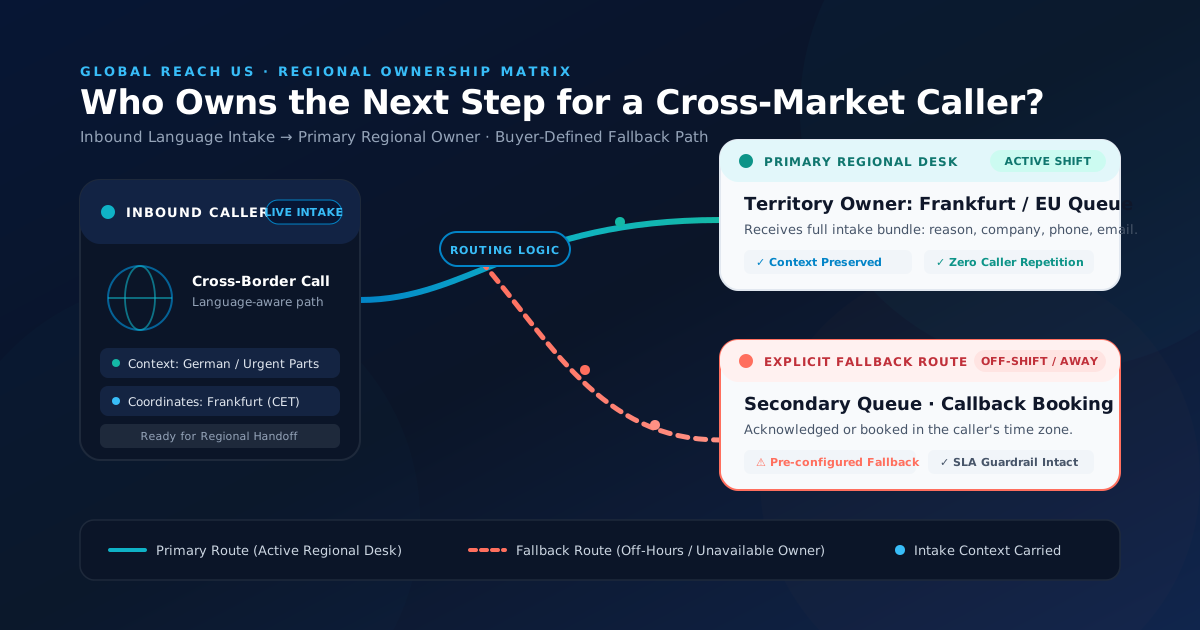
When an international caller dials into an expanding business, the first conversation is only half of the journey. Even if the call is answered smoothly in the caller's preferred language, the caller's request will stall if no one clearly owns what happens next.
Too often, cross-market calls suffer from organizational ambiguity:
- The European sales desk assumes the North American headquarters will return the call.
- Headquarters assumes the local regional office received the message.
- The caller waits in limbo across time zones, wondering if their request was received at all.
The direct answer is that every cross-market call requires a predetermined human next-step owner, an agreed bundle of intake context, and an explicit fallback route when that owner is unavailable.
Deciding who owns the next step is not an automated mystery—it is an operational choice that the business must define before inbound calls arrive.
1. Deciding which regional team owns the response
Before an organization configures call routing, operations leaders must define their regional ownership criteria. Depending on how your business operates, primary regional ownership generally follows one of four models:
- Geographic jurisdiction: The caller's physical location or stated country of operation determines the receiving regional office or territory team.
- Account or territory assignment: If the caller represents an existing client, distributor, or named account, ownership routes directly to their designated account manager or regional desk.
- Language-aware specialty: When technical, regulatory, or sales conversations require native fluency that only specific regional offices staff, the configured language path directs the request to that specialized team.
- Functional request classification: Inquiries are split by request type—such as new business inquiries routing to regional sales desks, while post-sale technical inquiries route to regional field support queues.
Organizations should avoid hybrid models that leave ownership uncertain. If a caller is based in Singapore but speaks Spanish, or dials from London regarding a project in Latin America, your call flow must have an explicit priority rule: does geographic location or language preference govern the first handoff? Settling this policy during initial setup prevents inquiries from bouncing unresolved between regional queues.
2. What context the receiving team needs to act
A regional handoff fails when the receiving team is given either too little information or an overwhelming dump of unstructured audio. A regional representative should never have to contact an international caller and ask them to repeat the entire conversation.
Under an approved language-aware intake flow, the structured context passed to the regional owner should contain:
- Stated business purpose: The exact question, project requirement, or service inquiry expressed by the caller.
- Caller identity and coordinates: Confirmed contact name, company name, call-back phone number, and email address.
- Regional and market context: The caller's country, time zone, or operational site.
- Configured language path: The language in which the inbound conversation took place, allowing the regional team to assign an appropriately fluent representative.
- Action status and requested next step: Whether the caller requested a scheduled follow-up meeting, a technical quote, or an urgent response.
By capturing these points systematically, the receiving team can review the context in seconds and initiate a tailored next step, preserving the credibility established during the initial call.
3. What fallback applies when the expected owner is unavailable
Operating across international borders introduces an inevitable reality: time-zone disparity and regional schedules. An international caller may reach your inbound line during standard business hours in Tokyo while your London team is off-shift, or dial from São Paulo on a regional holiday.
A dependable cross-market routing system must include an explicit, buyer-defined fallback path. When the primary regional owner is unreachable, businesses typically implement one of four fallback paths:
- Secondary regional queue (Follow-the-sun): If an organization maintains staffed operations across multiple continuous time zones, the inquiry can temporarily route to an active sister region for immediate acknowledgement, while preserving regional ownership for fulfillment.
- Central triage desk: Calls outside regional operating hours route to a central operations queue that monitors international inbound requests, verifies urgency, and assigns pending follow-ups to regional teams before their shift starts.
- Scheduled regional callback booking: Rather than leaving callback timing uncertain, the inbound flow offers the caller an approved booking window aligned with the receiving regional team's upcoming operating hours.
- Structured asynchronous dispatch: The intake record is formatted and dispatched immediately to the regional team's ticketing or communication queue, marked with the caller's local time zone to prevent representatives from returning calls in the middle of the caller's night.
Important boundary: Global Reach US does not provide human call center staffing, live human translators, or guaranteed response times. Your organization defines, staffs, and manages the actual response windows and fallback personnel.
4. The blank regional ownership matrix
To help regional operations leads establish clear ownership rules across their markets, use this blank regional ownership matrix. Complete one row for each international market or customer segment your business serves:
| Caller Market / Segment | Primary Regional Owner | Minimum Context Required | Fallback Path (When Primary Is Offline) | Target Follow-Up Window (Buyer-Staffed) |
|---|---|---|---|---|
| [e.g., European Union / UK] | [e.g., London Regional Desk] | [Stated need, company, country, language path] | [e.g., Central Triage Queue / Next-day regional slot] | [e.g., Within 4 local business hours] |
| [Define Market 1] | [Define Primary Team] | [Define Required Fields] | [Define Fallback Action] | [Buyer-determined target] |
| [Define Market 2] | [Define Primary Team] | [Define Required Fields] | [Define Fallback Action] | [Buyer-determined target] |
| [Define Market 3] | [Define Primary Team] | [Define Required Fields] | [Define Fallback Action] | [Buyer-determined target] |
| [Define Unmapped / Other] | [Define Default Team] | [Define Required Fields] | [Define Default Fallback] | [Buyer-determined target] |
Note: This framework is a planning tool for your operational design. Your organization determines which markets you support, who receives each handoff, and what follow-up service levels you maintain.
5. An illustrative scenario: Managing cross-market handoffs across time zones
To see how regional ownership rules operate in day-to-day practice, consider this practical scenario:
An industrial equipment distributor headquartered in Chicago sells replacement components across North America and Western Europe. The distributor uses Global Reach US to handle inbound phone inquiries across languages and time zones.
- 14:30 Central European Time (07:30 US Central Time): A procurement manager in Frankfurt calls the distributor's inbound line inquiring about urgent replacement pump valves for a manufacturing facility.
- Inbound intake: The caller is greeted in German through the configured language-aware path. The system captures the caller's company name, part specifications, delivery location, and callback details.
- Primary ownership determination: Under the company's regional ownership matrix, equipment inquiries from Germany belong to the European Regional Sales Desk in Frankfurt.
- Fallback activation: The Frankfurt sales representative is currently out of office on a site visit and unavailable for an immediate live transfer. The caller flow activates the pre-configured fallback route: the caller is informed that their complete request has been routed to the European sales team, and their preferred callback time (16:00 CET) is recorded.
- Structured notification: A structured summary detailing the pump model, location, and requested callback time is delivered directly to the Frankfurt team's queue. Simultaneously, an asynchronous alert is flagged for the Chicago operations desk as a secondary backstop.
- Resolution: When the Frankfurt representative returns to their desk at 15:15 CET, they review the structured record without needing a raw transcript. They return the call at 16:00 CET with pricing and inventory details already in hand.
This scenario is an illustrative example designed to demonstrate workflow planning; it does not represent an actual customer endorsement or specific transaction.
6. How setup and ongoing adjustments work
Establishing an effective cross-market routing flow does not require an enterprise engineering overhaul. Global Reach US is built around a transparent, sales-assisted setup process:
- Sales-assisted initial setup: During onboarding, you provide your business details, regional operating hours, approved language paths, intake questions, and team escalation rules. A sales agent assists in configuring the initial call flow to reflect your organizational structure.
- In-platform management: As regional assignments evolve, new team members join, or operating hours change, you can update your routing rules directly in the platform, with support available for additional guidance.
- Clear, predictable subscription terms:
- Base subscription: The standard AI Phone Agent subscription is $249 per month, month-to-month, with no setup or onboarding fees.
- Included allowances: Each monthly billing cycle includes 500 inbound minutes and 500 SMS.
- Usage overages: Additional usage is billed at $0.15 per additional minute and $0.03 per additional SMS.
- Flexibility: Cancel before your billing period concludes to prevent renewal for the subsequent month. Service remains active through the end of the paid period, and any incurred overages remain due. Refunds for prepaid monthly subscriptions are evaluated on a case-by-case basis.
For full contractual details, review the Global Reach US Terms of Service.
Next steps for your international inbound routes
A global inbound line should open doors for your business across languages and borders—not generate confused handoffs that frustrate international customers. When your organization clearly defines regional ownership, context requirements, and out-of-hours fallbacks, your team can respond with confidence no matter where a call originates.
- Ready to configure your cross-market routing? Map your regional handoff paths with Global Reach US or start phone service directly.
- Review the four-step inbound progression on our How It Works page.
- Learn what context needs to travel with each call in our regional handoff guide.
- Audit your routing readiness with our cross-market call routing checklist.
- Browse answers to common implementation questions in our inbound call FAQ.